How Was the De Lesepps Family Involved in Giving Statue of Liberty
| Ferdinand de Lesseps | |
|---|---|
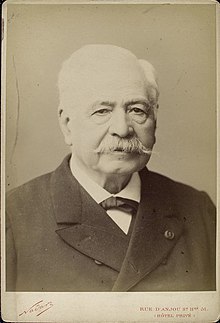 | |
| Born | (1805-eleven-19)19 November 1805 Versailles, French Empire |
| Died | 7 December 1894(1894-12-07) (anile 89) Guilly, France |
| Citizenship | France |
| Alma mater | Lycée Henri-Iv, Paris |
| Occupation | Diplomat, entrepreneur |
| Known for | Suez Canal, Panama Canal |
| Works | Recollections of twoscore years (1887) |
| Awards | Albert Medal (1870) |
| Signature | |
 | |
Ferdinand Marie, Count de Lesseps GCSI (French: [də lesɛps]; 19 November 1805 – 7 December 1894) was a French diplomat and later programmer of the Suez Canal, which in 1869 joined the Mediterranean and Blood-red Seas, substantially reducing sailing distances and times between Europe and Due east Asia.
He attempted to repeat this success with an effort to build a Panama Culvert at sea level during the 1880s, but the project was devastated by epidemics of malaria and yellowish fever in the area, as well every bit aggress by fiscal problems, and the planned Lesseps Panama Canal was never completed. Eventually, the projection was bought out by the United States, which solved the medical problems and changed the design to a non-bounding main level culvert with locks. It was completed in 1914.[1]
Ancestry [edit]
The origins of Lesseps' family unit are traceable dorsum every bit far as the end of the 14th century. His ancestors, information technology is believed, came from Kingdom of spain, and settled at Bayonne during the catamenia of English dominion in the region. One of his great-grandfathers, Pierre de Lesseps (Bayonne, 2 January 1690 – Bayonne, xx August 1759), son of Bertrand Lesseps (1649–1708) and wife (m. 18 April 1675) Louise Fisson (1654–1690), was town clerk and at the same fourth dimension secretary to Queen Maria Anna of Neuburg, widow of Charles II of Espana.
From the middle of the 18th century the ancestors of Lesseps followed diplomatic careers, and he himself occupied several diplomatic posts from 1825 to 1849. His uncle was ennobled past King Louis Xvi, and his male parent was made a count by Emperor Napoleon I. His father, Mathieu de Lesseps (Hamburg, iv May 1774 – Tunis, 28 December 1832), was in the consular service; his mother, Catherine de Grévigné (Málaga, 11 June 1774 – Paris, 27 January 1853), was Castilian on her mother's side, and aunt of the countess of Montijo, mother of the Empress Eugénie. She was a girl of Henri de Grevigné (baptised Notre-Dame-aux-Fonts, Liège, two June 1744) and wife (m. Málaga, 1766) Francisca Antonia Gallegos (1751–1853).
Early years [edit]
Ferdinand de Lesseps was built-in Nov 19, 1805 in Versailles, Yvelines. He had a sister, Adélaïde de Lesseps (1803–1879), married to Jules Tallien de Cabarrus (19 April 1801 – 1870), and ii brothers, Théodore de Lesseps (Cádiz, 25 September 1802 – Saint-Germain-en-Laye, xx May 1874), married in 1828 to Antonia Denois (Paris, 27 September 1802 – Paris, 29 Dec 1878), and Jules de Lesseps (Pisa, 16 February 1809 – Paris, x October 1887), married on xi March 1874 to Hyacinthe Delarue.
His first years were spent in Italy, where his male parent was occupied with his consular duties. He was educated at the College of Henry IV in Paris. From the age of eighteen years to 20 he was employed in the commissary department of the army. From 1825 to 1827 he acted as assistant vice-consul at Lisbon, where his uncle, Barthélemy de Lesseps, was the French chargé d'affaires. This uncle was an sometime companion of Jean-François de La Pérouse and the only survivor of the expedition in which La Pérouse perished. Barthélemy de Lesseps had left the expedition in Kamchatka to travel to St Petersburg overland.
Career [edit]
Diplomatic [edit]
In 1828 Lesseps was sent as an assistant vice-consul to Tunis, where his father was consul-general. He aided the escape of Youssouff, pursued by the soldiers of the Bey, of whom he was 1 of the officers, for violation of the seraglio law. Youssouff acknowledged this protection given by a Frenchman past distinguishing himself in the ranks of the French army at the fourth dimension of the French conquest of People's democratic republic of algeria. Lesseps was also entrusted by his begetter with missions to Align Count Bertrand Clausel, general-in-chief of the army of occupation in People's democratic republic of algeria. The marshal wrote to Mathieu de Lesseps on xviii December 1830: "I have had the pleasure of meeting your son, who gives promise of sustaining with great credit the proper noun he bears."
In 1832 Lesseps was appointed vice-consul at Alexandria. While the vessel, in which Lesseps sailed to Egypt, was in quarantine at the Alexandrian lazaretto, M. Mimaut, consul-general of France at Alexandria, sent him several books, among which was the memoir written upon the previously filled and abandoned Aboriginal Suez Canal, co-ordinate to Napoleon Bonaparte's instructions, by the civil engineer Jacques-Marie Le Père, one of the scientific members of the French expedition.
This work struck Lesseps'due south imagination, and was one of the influences that gave him the idea of amalgam a canal beyond the African isthmus. Fortunately for Lesseps, Muhammad Ali, the viceroy of Egypt, owed his position in role to the recommendations fabricated on his behalf to the French government by Lesseps himself, who was consul-full general in Egypt when Ali was a colonel. Because of this, Lesseps received a warm welcome from the viceroy and became good friends with his son, Said Pasha. Politically, the British were allied with the Ottoman government in Istanbul (doing so in order to prevent the Russians from gaining admission to the Mediterranean) and had likewise assisted in repelling Ali'south try to capture Istanbul in 1833. The French were able to manoeuvre in Egypt under Ali'south graces by playing off the British intervention against Ali in Istanbul.[2]
In 1833 Lesseps was sent as consul to Cairo, and before long afterwards given the management of the consulate general at Alexandria, a post that he held until 1837. While in Egypt he encountered and was influenced by Barthélemy Prosper Enfantin, who was working on a dam north of Cairo for Ali while preaching for a union of the Mediterranean and Ruddy Seas.[3] While he was there an epidemic of plague broke out and lasted for two years, resulting in the deaths of more than a third of the inhabitants of Cairo and Alexandria. During this time Lesseps went from one metropolis to the other with zeal and energy. Towards the close of the year 1837 he returned to France, and on 21 December married Agathe Delamalle (1819–1853), daughter of the government prosecuting attorney at the courtroom of Angers. By this union de Lesseps became the begetter of five sons: Charles Théodore de Lesseps (1838–1838), Charles Aimé de Lesseps (1840–1923), Ferdinand Marie de Lesseps (1842–1846), Ferdinand Victor de Lesseps (1847–1853) and Aimé Victor de Lesseps (1848–1896).
In 1839 Lesseps was appointed consul at Rotterdam, and in the post-obit yr transferred to Málaga, the bequeathed home of his mother's family. In 1842 he was sent to Barcelona, and before long afterwards promoted to the form of consul general. In the course of a bloody insurrection in Catalonia, which ended in the bombardment of Barcelona, de Lesseps offered protection to a number of men threatened past the fighting regardless of their factional sympathies or nationalities. From 1848 to 1849 he was minister of France at Madrid.
In 1849 the government of the French Democracy sent Lesseps to Rome to negotiate the return of Pope Pius 9 to the Vatican. He tried to negotiate an understanding whereby Pope Pius could render peacefully to the Vatican but as well ensuring the connected independence of Rome. Only, during negotiations, the elections in French republic caused a alter in the strange policy of the authorities – Alexis de Tocqueville replaced the previous foreign minister. Lesseps course was disapproved; he was recalled and brought earlier the Quango of State. Louis-Napoleon needed a scapegoat and Lesseps was an easy target. Lesseps was defendant of causing dishonor to the French army and was censured although he was not told to go out the Strange Ministry.[4]
Lesseps was created on thirty Baronial 1851 the 334th Commander and so the 200th Thousand Cross of the Gild of the Tower and Sword.
Lesseps then retired from the diplomatic service, and never again occupied any public office. In 1853 he lost his wife and his son Ferdinand Victor at a few days' interval. In 1854, the accession to the viceroyalty of Egypt of Said Pasha gave Lesseps a new impulse to human activity upon the cosmos of a Suez Canal.
Suez Canal [edit]


Lesseps' statue at the entrance of the Suez Culvert, 1955; the outstretched hand indicated that the way was at present open to the East.

Lesseps' statue displayed today in front of the Suez Canal International Museum in Ismailia.
Lesseps had corresponded at least once with the Société d'Études du Canal de Suez during the reign of Abbas I in Egypt, simply Abbas had closed off virtually of Arab republic of egypt to foreign influence. Upon Abbas' assassination in 1854, Lesseps, made inquiries with a former, if short-term, acquaintance and successor in Egypt, Said Pasha. On 7 November 1854 he landed at Alexandria; on the 30th of the same month Said Pasha signed the concession authorizing him to build the Suez Culvert.[five]
A first scheme, initiated past Lesseps, was immediately drawn out past two French engineers who were in the Egyptian service, Louis Maurice Adolphe Linant de Bellefonds chosen "Linant Bey" and Mougel Bey. This project, differing from others that were previously presented or that were in opposition to it, provided for a direct link betwixt the Mediterranean and the Blood-red Ocean. After beingness slightly modified, the plan was adopted in 1856 by the civil engineers constituting the International Commission for the piercing of the isthmus of Suez. Encouraged by the engineers' approval, Lesseps no longer allowed anything to stop him. He listened to no adverse criticism and receded before no obstruction. Neither the opposition of Lord Palmerston, who considered the projected disturbance equally too radical and a threat to the commercial position of the British Empire. Lesseps was similarly not deterred by the opinions entertained, in French republic too every bit in Uk, that the sea in front of Port Said was total of mud which would obstruct the archway to the culvert, and that the sands from the desert would fill up the trenches.[ citation needed ]
Lesseps succeeded in rousing the patriotism of the French and obtaining by their subscriptions more half of the capital of two hundred 1000000 francs which he needed in lodge to form a company, but could not concenter any substantial upper-case letter contribution from the full general public in British or other strange countries. The Egyptian government thus subscribed for eighty million francs worth of shares.[ citation needed ]
The Compagnie universelle du canal maritime de Suez was organized at the end of 1858. On 25 April 1859 the first blow of the pickaxe was given by Lesseps at Port Said. During the post-obit 10 years, Lesseps had to overcome the continuing resistance of the British government, which kept the Sultan from approving the structure of the culvert; at ane stage even seeking the support of his cousin, Empress Eugenie, to persuade the Emperor Napoleon III to act equally arbitrator in the disputes. Finally, on 17 November 1869, the culvert was officially opened by the Khedive, Ismail Pasha.[ citation needed ]

Ferdinand de Lesseps' house and office in Ismailia, virtually the Suez Culvert
While in the interests of his canal Lesseps resisted British authorities opposition to an enterprise which threatened to give France control of the shortest route to Republic of india, he acted favourably towards Britain's interests after Benjamin Disraeli acquired the Suez shares belonging to the Khedive, by admitting to the board of directors of the company three representatives from the government of Britain. The consolidation of interests which resulted, and which was strengthened past the addition in 1884 of vii more British directors, chosen from among shipping merchants and business men, increased, for the benefit of all concerned, the commercial grapheme of the enterprise.[ citation needed ]
Lesseps steadily endeavored to keep out of politics. If in 1869 he appeared to deviate from this principle past existence a candidate at Marseille for the Corps Législatif, it was because he yielded to the entreaties of the Majestic government in club to strengthen its goodwill for the Suez Canal. Once this goodwill had been shown, he bore no malice towards those who rendered him his liberty past preferring Léon Gambetta. Subsequently, Lesseps declined the other candidatures that were offered to him: for the Senate in 1876, and for the Chamber in 1877. In 1873 he became interested in a project for uniting Europe and Asia by a railway to Mumbai, with a branch to Beijing. The same twelvemonth, he became a fellow member of the French Academy of Sciences. He afterward encouraged Major Roudaire, who wished to transform a stretch of the Sahara into an inland sea to increment rainfall in Algeria.[vi]
Lesseps accepted the presidency of the French commission of Leopold 2 of Belgium's International African Guild. From this position he facilitated Pierre Savorgnan de Brazza's explorations, and acquired stations that Brazza subsequently abandoned to the French government. These stations were the starting-indicate of French Congo. Lesseps was elected a Foreign Honorary Member of the American Academy of Arts and Sciences in 1879.[7]
From 17 November 1899 to 23 December 1956, a awe-inspiring statue of Ferdinand de Lesseps by Emmanuel Frémiet stood at the entrance of the Suez Canal.[8] [9]
Panama Canal attempt [edit]

Share of the Compagnie Universelle du Canal Interocéanique de Panama, issued 29. November 1880 – signed by Ferdinand de Lesseps
In May 1879 a congress of 136 delegates (including Lesseps) assembled in the rooms of the Société de géographie in Paris, under the presidency of Admiral de la Roncire le Noury, and voted in favor of the creation of a Panama Canal, which was to be without locks, like the Suez Canal. Lesseps was appointed President of the Panama Canal Company, despite the fact that he had reached the age of 74. It was on this occasion that Gambetta bestowed upon him the championship of "Le Grand Français". However, the decision to dig a Panama Culvert at ocean level to avert the use of locks, and the disability of contemporary medical scientific discipline to deal with epidemics of malaria and yellow fever, doomed the project.

In Feb 1880, Lesseps arrived in New York City to heighten money for the projection. When he stayed at the Windsor Hotel, its staff flew the French flag in his honor. He met the American Lodge of Ceremonious Engineers and the Geographic Lodge while touring the expanse. Lesseps then went to Washington D.C., met with President Rutherford B. Hayes, and testified to the House Interoceanic Canal Commission. He later went to Boston, Chicago, and several other American cities to raise involvement and uppercase for the project.[ten]
In June 1880, Lesseps gave a speech in Liverpool where he was able to discover back up from a Captain Peacock, who felt the canal project was worth supporting as it would provide routes to save time.[xi]
Lesseps went with his youngest kid to Panama to see the planned pathway. He estimated in 1880 that the project would accept 658 million francs and 8 years to complete. Subsequently 2 years of surveys, piece of work on the culvert began in 1882. However, the technical difficulties of operating in the wet tropics dogged the project. Particularly disastrous were recurrent landslides into the excavations from the bordering water-saturated hills, and the death toll from malaria and yellow fever. In the end, bereft financial capital and financial corruption concluded the project. The Panama Canal Visitor declared itself bankrupt in Dec 1888 and entered liquidation in February 1889.
The failure of the project is sometimes referred to as the Panama Culvert Scandal, subsequently rumors circulated that French politicians and journalists had received bribes. By 1892 it emerged that 150 French deputies had been bribed into voting for the allocation of financial aid to the Panama Canal Company, and in Feb 1893 Lesseps, his son Charles (built-in 1849), and a number of others faced trial and were found guilty. Lesseps was ordered to pay a fine and serve a prison sentence, but the latter was overturned by the Courtroom of Cassation on the grounds that it had been more than than three years since the crime was committed. Ultimately, in 1904 the United states of america bought out the avails of the Company and resumed piece of work under a revised plan.
2d marriage and issue [edit]
In Paris on November 25, 1869—a week after the opening of the Suez Culvert—Lesseps married his second wife, who was a third his age. Louise-Hélène Autard de Bragard was born on the isle of Mauritius in 1848 at Plaines Wilhems and died on 29 Jan 1909 at Château de La Chesnay in Guilly, Vatan, Indre. She was the daughter of Gustave Adolphe Autard de Bragard, a former Magistrate of Republic of mauritius, and wife Marie-Louise Carcenac (1817–1857), daughter of Pierre Carcenac (1771–1819) and wife Marie Françoise Dessachis. Eleven of her twelve children (six boys and 6 girls) with Lesseps survived their father:
- Mathieu Marie de Lesseps (1870–1953)
- Ferdinand-Ismaël de Lesseps (1871–1915)
- Ferdinande de Lesseps (1872–1948), married firstly in Paris on x May 1890 to Ferdinand de Gontaut-Biron (1868–1898), of the Marquesses of Saint-Blancard, by whom she had a son Ferdinand de Gontaut-Biron (1892–1892), and married secondly François-Joseph de Cassagne de Beaufort, Marquis de Miramon (1867–1932)
- Eugénie Marie de Lesseps (1873–1874)
- Bertrand de Lesseps (1875–1918)
- Marie Consuelo de Lesseps (1875–1944)
- Marie-Eugénie de Lesseps (1876–1958), married in Paris on xi December 1900 to François du Bouays de La Bégassière (1875–1914), and had issue:
- Jacques du Bouays de La Bégassière, married to Joyce Blaffer,[12] with effect.
- Jeanne Marie Jacqueline du Bouays de La Bégassière (1907–1998), married to Jean de Contades (1902–1977; son of Jean de Contades and Rosa Augusta de los Dolores Guzmán y Zayas-Bazán), with event:
- Yvonne de Contades (b. 1928), married on 27 Jan 1951 to Bernard, Count of Harcourt (1925–1958; son of Bruno, Count of Harcourt and Princess Isabelle of Orléans), with issue
- Antoine de Contades (b 1932), married on 15 Nov 1963 to Daphne Jean Jefferson, with issue. A son Yves de Contades
- Marie Solange de Lesseps (1877–?), married in Paris on 12 Jan 1910 to Don Fernando Mexía y Fitz-James-Stuart (1881–?), 6th Duke of Tamames, 3rd Duke of Galisteo and 12th Count of Mora, and had result
- Paul Marie de Lesseps (1880–1955)
- Robert de Lesseps (1882–1916), married February 27, 1902 to Marthe Josepha Sophie Allard (1884–1970), and had issue:
- Nicole de Lesseps
- Robert Martin de Lesseps (1915–1981), married in London on 11 August 1945 to Beatrice Duggan (1922– ), and had event:
- Claire de Lesseps (1956– ), married to Johann, Graf von Gudenus (1952– ), and has outcome, one son and two daughters
- Count Jacques Benjamin de Lesseps (1883–1927), aviator, married Grace McKenzie 1911
- Gisele de Lesseps (1885–1973)
Statue of Liberty [edit]
On 11 June 1884, Levi P. Morton, the Minister of the U.s. to France, gave a banquet in laurels of the Franco-American Matrimony and in celebration of the completion of the Statue of Freedom. Ferdinand de Lesseps, every bit head of the Franco-American Union, formally presented the statue to the United States, saying:
This is the result of the devoted enthusiasm, the intelligence and the noblest sentiments which can inspire man. It is great in its conception, great in its execution, corking in its proportions; permit u.s. hope that it will add, by its moral value, to the memories and sympathies that it is intended to perpetuate. We now transfer to you, Mr. Minister, this corking statue and trust that it may forever stand the pledge of friendship between French republic and the Great Republic of the United states.
In October 1886, Lesseps traveled to the United States to speak at the dedication ceremony of the Statue of Liberty on the engagement of the 28th, and attended by President Grover Cleveland.
Death [edit]

Lesseps died at Château de La Chesnaye in Guilly, Vatan, Indre, on 7 December 1894. He was buried in Père Lachaise Cemetery in Paris.[13] The grave stands at one of the junctions amidst other large family tombs.
Legacy [edit]
On 26 July 1956, Egyptian President Gamal Abdel Nasser used de Lesseps' surname as the codeword to Egyptian personnel designated to seize the offices of Suez Canal Company. Nasser used the codeword repeatedly in a public address in Alexandria that was broadcast to the nation via radio, and minutes afterwards appear that he had issued a presidential decree nationalising the Suez Canal Company. The statue of Lesseps at the archway of the Suez Canal was removed from its pedestal, to symbolize the end of European control of the waterway. The statue now stands in a small-scale garden of the Port Fuad shipyard.
In popular culture [edit]
Lesseps was portrayed past Tyrone Power in the 1938 film Suez, with Loretta Young, a motion picture which provoked complaints and legal activity from Lesseps' family unit and the Egyptian government.[14]
In improver, Manuel Soto played the role in a 1944 Spanish feature film, Eugenia de Montijo. On goggle box, Guy Marchand played Lesseps in the 1983 French/High german mini-series L'homme de Suez, and John Walters portrayed him in "The Panama Canal", an episode of the 2003 BBC docu-drama serial Seven Wonders of the Industrial World.[15]
Lesseps appears as a keen engineer in the game Civilization V.
Lesseps is too discussed extensively in the David McCullough volume, The Path Between the Seas.
Lesseps descendant, Alex de Lesseps, was married to Luann de Lesseps of Real Housewives of New York.
Come across also [edit]
- Lesseps metro station in the Barcelona Metro
- Fort De Lesseps, a U.S. military base in Panama was named in his honor
References [edit]
- ^ McCullough 1977. sfn mistake: no target: CITEREFMcCullough1977 (help)
- ^ Karabell, Zachary (2003). Parting the desert: the creation of the Suez Canal. Alfred A. Knopf. p. 43. ISBN0-375-40883-five.
- ^ Karabell, Zachary (2003). Departing the desert: the cosmos of the Suez Canal. Alfred A. Knopf. pp. 31–37. ISBN0-375-40883-five.
- ^ Karabell, Zachary (2003). Parting the desert: the creation of the Suez Canal. Alfred A. Knopf. p. 63. ISBN0-375-40883-five.
- ^ Karabell, Zachary (2003). Parting the desert: the creation of the Suez Culvert. Alfred A. Knopf. pp. 58–61, 65, 70–71, 76. ISBN0-375-40883-5.
- ^ The Inland African Sea. The report. The New York Times. 16 September 1877
- ^ "Book of Members, 1780–2010: Chapter Fifty" (PDF). American University of Arts and Sciences. Retrieved 23 September 2016.
- ^ Ferdinand de Lesseps statue Archived 2009-03-31 at the Wayback Machine
- ^ The Destruction of the statue of de Lesseps [ permanent expressionless link ]
- ^ Parker, Matthew. Panama Fever: The Epic Story of One of the Greatest Achievements of All Time – the Building of the Panama Canal. New York: Doubleday, 2007. pp. 81–84.[ ISBN missing ]
- ^ Lesseps, Ferdinand de (June 1880). "Address on the Inter-Oceanic Canal Scheme". Strange and Republic Part Collection.
- ^ Obituary of Joyce Blaffer de La Bégassière von Bothmer, Dodge-Thomas Funeral Dwelling.
- ^ Cimetières de France et d'ailleurs
- ^ "Notes" on TCM.com
- ^ "Ferdinand de Lesseps (Character)" on IMDB.com
Sources [edit]
- This article incorporates text from a publication at present in the public domain:Chisholm, Hugh, ed. (1911). "Lesseps, Ferdinand de". Encyclopædia Britannica. Vol. sixteen (11th ed.). Cambridge University Printing. pp. 494–496.

Further reading [edit]
- Smith, Thou Barnett The Life and Enterprises of Ferdinand de Lesseps (London, 1893)
- de Lesseps, Ferdinand, Souvenirs de quarante ans (trans. past CB Pitman).
- Karabell, Zachary (2003). Parting the Desert: The Creation of the Suez Culvert. New York: Knopf. ISBN978-0375408830.
- McCullough, David, The Path Between the Seas: The Creation of the Panama Culvert 1870–1914 Simon and Schuster, 1977.
- Parker, Matthew. Panama Fever: The Epic Story of One of the Greatest Human Achievements of All Time – the Edifice of the Panama Canal. New York: Doubleday,
- Simon, Maron J. The Panama Affair Charles Scribner's Sons, 1971.[ ISBN missing ]
External links [edit]
- Works by Ferdinand de Lesseps at Open up Library
- Ferdinand de Lesseps (1887). Recollections of forty years. Volume 1. Volume 2. From Net Annal.
- André Gill (1867). "Ferdinand de Lesseps", caricature painting of Ferdinand de Lesseps.
- The Delesseps Family Archived 2010-11-23 at the Wayback Machine: This folio focuses on Viscount de Lesseps' family unit
- The A.B. Nichols archival collection Archived 2011-07-27 at the Wayback Motorcar of documents and materials related to the Panama Culvert includes a number of references to the French projection, including photographs of de Lesseps and his house in Panama.
- Associació de Veïns i Comerciants de la Plaça Lesseps, Gràcia, Barcelona, Catalonia
- Works by Ferdinand de Lesseps at LibriVox (public domain audiobooks)

- Paper clippings nigh Ferdinand de Lesseps in the 20th Century Press Athenaeum of the ZBW
Source: https://en.wikipedia.org/wiki/Ferdinand_de_Lesseps
0 Response to "How Was the De Lesepps Family Involved in Giving Statue of Liberty"
Postar um comentário