What Did the Candidates Say Each Other About Their Families in Election 1828 and 2016
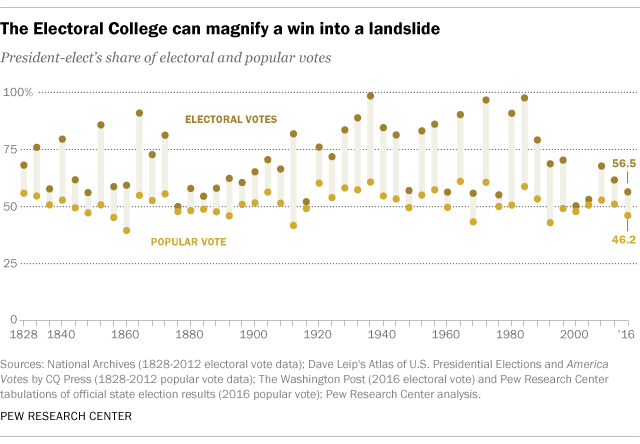
For the 5th time in U.South. history, and the second fourth dimension this century, a presidential candidate has won the White House while losing the popular vote.
In this calendar week'southward Balloter College balloting, Donald Trump won 304 balloter votes to Hillary Clinton's 227, with 5 Democratic and 2 Republican "faithless electors" voting for other people. That upshot was despite the fact that Clinton received well-nigh 2.ix million more popular votes than Trump in Nov's election, co-ordinate to Pew Research Center's tabulation of state ballot results. Our tally shows Clinton won 65.viii million votes (48.25%) to about 63 meg (46.15%) for Trump, with small-party and contained candidates taking the rest.
This mismatch between the balloter and pop votes came about because Trump won several big states (such every bit Florida, Pennsylvania and Wisconsin) by very narrow margins, gaining all their electoral votes in the process, even as Clinton claimed other large states (such equally California, Illinois and New York) past much wider margins. Trump's share of the pop vote, in fact, was the seventh-smallest winning percent since 1828, when presidential campaigns began to resemble those of today.
In fact, the very nature of the fashion the U.S. picks its presidents tends to create a disconnect between the result in the Electoral College and the popular vote. The last time a popular-vote loser won the presidency in the Electoral College was, of course, in 2000, when George West. Bush-league edged out Al Gore 271-266 despite Gore winning some 537,000 more popular votes nationwide. The other electoral-popular vote mismatches came in 1876 and 1888; in all 4 instances the Democratic nominee ended upwardly the loser. (In the 1824 election, which was contested between rival factions of the old Autonomous-Republican Party, Andrew Jackson won a plurality of the popular and balloter vote, but considering he was short of an Electoral College majority the election was thrown to the House of Representatives, which chose runner-upwards John Quincy Adams.)
Even in the vast bulk of U.Due south. elections, in which the aforementioned candidate won both the popular and the electoral vote, the organisation commonly makes the winner'south victory margin in the former a lot wider than in the latter. In 2012, for example, Barack Obama won 51% of the nationwide popular vote but nearly 62% of the electoral votes, or 332 out of 538.
Looking back at all presidential elections since 1828, the winner's electoral vote share has, on average, been 1.36 times his popular vote share – what we'll call the electoral vote (EV) inflation factor. Trump's EV inflation factor, based on his winning 56.5% of the electoral votes (304 out of 538) is i.22, like to Obama'southward in 2012 (1.21).
A quick Electoral College refresher: The 538 electors allocated (mainly by population) among the 50 states and the District of Columbia actually choose the president and vice president, with a bulk of balloter votes (i.eastward., 270) needed for an outright win. All but two states use a plurality winner-take-all system to option their presidential electors – whoever receives the most votes in a state wins all of its electoral votes, even if he or she got less than a majority of the pop vote. (Maine and Nebraska award some of their electoral votes by congressional district rather than statewide; that enabled Trump to win one of Maine'south four balloter votes, for the state's 2nd District, even though Clinton won the country overall.)
The biggest disparity betwixt the winning electoral and popular votes, with an EV inflation factor of 1.96, came in 1912 in the four-way slugfest between Democrat Woodrow Wilson, Republican incumbent William Howard Taft, Progressive Theodore Roosevelt (who had bolted from the Republicans) and Socialist Eugene 5. Debs. Wilson won a whopping 82% of the electoral votes – 435 out of 531 – with less than 42% of the overall pop vote. (In fact, Wilson won popular vote majorities in merely 11 of the 40 states he carried – all in what was and then the solidly Autonomous Due south.)
The next biggest gap was the 1980 "Reagan landslide." In that three-way competition, Ronald Reagan took just under 51% of the popular vote, to Jimmy Carter's 41% and independent John Anderson's half dozen.6%. Merely Reagan soared past Carter in the Electoral College: 489 electoral votes (91% of the total) to 49, for an EV inflation cistron of i.79.
Many of the elections with the virtually-inflated balloter votes featured prominent third-party candidates, who served to hold down the winners' pop vote share without existence meaning Balloter College players themselves. On the other hand, when the ii major-political party nominees ran fairly evenly and in that location were no notable independents or third parties, the Electoral Higher vote has tended to be much closer to the popular tally. In 2004, for instance, incumbent Bush won a second term with but under 51% of the pop vote and 53% of the electoral votes (286 out of 538).
A notable feature of the 2016 Electoral College vote was the tape number of and then-called "faithless electors" – electors who bandage their ballots for someone other than the official nominee of the party they're pledged to represent. The v Democratic electors who voted for people other than Clinton included iii from Washington Country who chose Colin Powell and another who chose Yankton Sioux tribal elder Organized religion Spotted Eagle, and one from Hawaii who voted for Vermont Sen. Bernie Sanders, Clinton'due south rival in the primaries. In addition, the two Texas electors who spurned Trump voted instead for Ohio Gov. John Kasich (whom Trump had defeated in the primaries) and erstwhile U.South. Rep. Ron Paul.
Annotation: This is an update of a postal service originally published November. 3, 2016.
Source: https://www.pewresearch.org/fact-tank/2016/12/20/why-electoral-college-landslides-are-easier-to-win-than-popular-vote-ones/
0 Response to "What Did the Candidates Say Each Other About Their Families in Election 1828 and 2016"
Postar um comentário